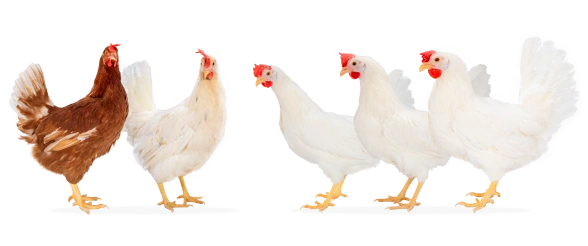

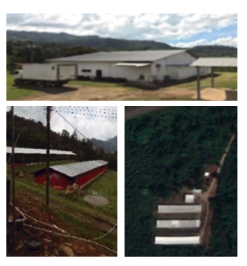
 INHASA, short for Industria Avicola Hondurena SA, was founded in 2002. It was acquired by the Samara Family in 2010. The company is well known in Honduras and beyond country borders. CEO Maria Cristina Samara moved the company into a new direction with a sole focus on parent stock.
 One year after I moved to Honduras, I got married. At that time, my husband was the one that drove the business. Through him and through our family I, too, got insights and the ability to overlook everything, including how production and distribution happened.
But to be honest, at that time I wasn’t really interested in taking an active role. I did not go into all details yet. If our business worked, it worked and if it did not, we’d put the blame on ourselves and we would try harder next time.
What decisions were these?
In the past, we had also been in the egg production and selling business. The results we achieved came at too much effort, so our return on investment wasn’t good. There was a lot of internal discussion, but there were also external ups and downs, like the egg price. The egg price was something beyond our control, it was an external force with too much momentum. It tied us down and in the long run, threatened to drain the business.
But I had children to raise, and I also felt obliged to continue and keep supporting the family I had created. I don’t like to depend on external factors that are hard to control.
So, because revenue from the egg business was little, we finally closed our egg production and selling business, despite it being equipped with very modern facilities. Instead, we decided to really focus on our parent stock business.
As said, it was a tough decision to make, but it had to made, change was needed. And it was good. But, of course, people needed to be convinced about it, too. I showed them the numbers and hard facts, and we all communicated a lot with one another to explain the reasoning behind this decision and to map our way into the future. In hindsight it worked very well.
You certainly had a fresh view on things and new ideas – what were these?
As I mentioned one of the changes was to just do parent stock and selling day old pullets. That was a big change.
Another view was that we wanted to achieve national recognition of our business. We got it and later I saw the chance to expand into other countries in Central America. To achieve that we had to do what we already did, but even better and on a greater scale. So, the new focus will further grow the businesses and create new achievements for the company.
One year after I moved to Honduras, I got married. At that time, my husband was the one that drove the business. Through him and through our family I, too, got insights and the ability to overlook everything, including how production and distribution happened.
But to be honest, at that time I wasn’t really interested in taking an active role. I did not go into all details yet. If our business worked, it worked and if it did not, we’d put the blame on ourselves and we would try harder next time.
What decisions were these?
In the past, we had also been in the egg production and selling business. The results we achieved came at too much effort, so our return on investment wasn’t good. There was a lot of internal discussion, but there were also external ups and downs, like the egg price. The egg price was something beyond our control, it was an external force with too much momentum. It tied us down and in the long run, threatened to drain the business.
But I had children to raise, and I also felt obliged to continue and keep supporting the family I had created. I don’t like to depend on external factors that are hard to control.
So, because revenue from the egg business was little, we finally closed our egg production and selling business, despite it being equipped with very modern facilities. Instead, we decided to really focus on our parent stock business.
As said, it was a tough decision to make, but it had to made, change was needed. And it was good. But, of course, people needed to be convinced about it, too. I showed them the numbers and hard facts, and we all communicated a lot with one another to explain the reasoning behind this decision and to map our way into the future. In hindsight it worked very well.
You certainly had a fresh view on things and new ideas – what were these?
As I mentioned one of the changes was to just do parent stock and selling day old pullets. That was a big change.
Another view was that we wanted to achieve national recognition of our business. We got it and later I saw the chance to expand into other countries in Central America. To achieve that we had to do what we already did, but even better and on a greater scale. So, the new focus will further grow the businesses and create new achievements for the company.
 Female directors are rather rare in this business – what do you do differently than male colleagues, if anything? Do you apply a certain/ different style of leadership as a female director?
I wouldn’t call it a certain style, but females very often must put in double the effort. I see this positive however, because it tells a lot about the woman behind a successful project.
I think when you believe in something strongly, then, people will start to understand. It is also a matter of being persistent. It takes determination, you must be absolutely convinced about your mission. You must be clear, and you must be courageous.
Female directors are rather rare in this business – what do you do differently than male colleagues, if anything? Do you apply a certain/ different style of leadership as a female director?
I wouldn’t call it a certain style, but females very often must put in double the effort. I see this positive however, because it tells a lot about the woman behind a successful project.
I think when you believe in something strongly, then, people will start to understand. It is also a matter of being persistent. It takes determination, you must be absolutely convinced about your mission. You must be clear, and you must be courageous.

I think when you believe in something strongly, then, people will start to understand. It is also a matter of being persistent. It takes determination, you must be absolutely convinced about your mission. You must be clear, and you must be courageous.
I really am the hardest on myself. I try to set a good example and show everybody at all levels of the company that obstacles can be overcome.
Of course, it is also about communicating with one another. You must listen carefully to one another. You have to respect processes, structures and at the same time, always be ready to reach out and give a hand to someone who is not catching up as fast.
I hold people accountable and try to enable them to take their own decisions because they understand the full scope and impact of their task, they must understand their contribution and their role in the big picture. Because they are a vital part of it.
I try to establish a constructive attitude to dealing with mistakes and using them as lessons learned, so we can avoid them next time. But that implies being able to discover and understand the impact of mistakes. It is not easy to be strict and never lose sight of the common goals, and to constantly involve, convince and empower people.
What are your preferred leadership instruments in a day-to-day business? From a personal attitude and point of view that is commitment, determination and persistency. Being hard on myself. It is always a tight rope walk between being accessible and involving and keeping a straight focus.1
The first important thing is to understand what employees do exactly, what their job description is. I needed to understand everybody’s’ work routines, so I know for example how long the procedures at the farm take. And I know that because I’ve done them myself. This is how I got my reference point: When I, as an untrained person, can do things in a certain time, a trained specialist will be able to do them better than me. Likewise, when I train someone new, I don’t just talk but demo it in their own work environment.2
The second important thing is a trusted team in administration and finance that shares your goals. I work with external support, too. Because I am not afraid to admit whenever I don’t know something. But I don’t leave it like that, I get help and learn what there is to learn. For example, I contracted an outside expert to teach me, and I also brought this person in front of all employees because I saw the value for the team.3
Thirdly, as my strategy, I can say that I keep a close and good relationship to employees, but my job is also to keep a clear view ahead.4
And as a fourth element, I think successful business is also about a network of people with different capabilities. It’s about forming alliances of mutual benefit. Therefore, we signed an agreement with another company in broiler production, who is going to use part of our hatchery facilities, in exchange for upgrading some of our machines and supporting us in staff-training. Not everyone can know everything, but together everybody can know more. Would you encourage other females to pursue a career like you did? Sure, females and males alike. Anyone ready to work hard towards a clear goal has the opportunity to reach it, and even go beyond. And to inspire others to do the same. But a woman in many business fields has to prove that she can do the job and that she can give new impulses and inspirations on top. 100% won’t do. She has to show it at 200%. I find this especially true in my business. I came from another country, and I also had to acquire much of the business knowledge in a very short period with a lot of other challenges on my plate. I had to show my determination, I had to go into the barn and learn processes first-hand. And I did. I immersed myself into it head-on. In the face of obstacles, did you ever question your decision? Do you mean having taken my family somewhere else for an easier new beginning? No. When I married my husband it was a wholehearted decision. I feel obliged to keep up this families’ work, and also to keep workplaces for employees. Besides, I know about the great potential we have here. When I say I don’t like to depend on things, that includes not being limited by obstacles. They should not have the power to tie you down when there are opportunities within reach that everybody can benefit from. What do you enjoy most or find the easiest in this business? A lot of time each day is spent in the office, from 7 o’clock in the morning till 6 o’clock in the evening. I also spend time at the farms at least twice per week. It makes me happy to see the birds happy and in good shape. Despite all the hard work, being around animals gives me a feeling of relaxation and happiness.A woman in many business fields has to prove that she can do the job and that she can give new impulses and inspirations on top. 100% won’t do. She has to show it at 200%.
 What do you find is the hardest part??
Seeing the birds sick, seeing unnecessary mistakes happen, seeing us limiting ourselves.
I keep pushing limits and I also often create pressure, but I don’t particularly like it. Actually it’s the numbers create that pressure, I only voice it and try to wake everybody up to the hard facts and the steps we need to take for better results and corrective action. For our own good. That part of leadership requires a lot of persistency and communication.
That surely requires a lot of power and energy, too. What are your sources to take them from? What keeps you going every day?
What do you find is the hardest part??
Seeing the birds sick, seeing unnecessary mistakes happen, seeing us limiting ourselves.
I keep pushing limits and I also often create pressure, but I don’t particularly like it. Actually it’s the numbers create that pressure, I only voice it and try to wake everybody up to the hard facts and the steps we need to take for better results and corrective action. For our own good. That part of leadership requires a lot of persistency and communication.
That surely requires a lot of power and energy, too. What are your sources to take them from? What keeps you going every day?
I believe in what we can achieve together. I believe in our employees. Already from the start the founders of the company believed in the capability of the H&N breed, and they were right. Our results show that clearly. Also, the way competitors react to our success speaks volumes. But our success is not meant to threaten them. Much more we would like to inspire what is possible with hard work on your own premise.
Is there a secret recipe of success? First and foremost, I wanted to give a good example for my own children. I wanted them to grow up with strong and independent personalities, and I am very proud of them because they all succeeded very well in doing so. Apart from that, I would say that in general, it takes creativity, and the ability to form alliances of mutual benefit. For example, with that broiler company. Joining forces, using processes together, finding synergies and complementing business instead of competing makes everybody stronger. But to seize such opportunities and find value in partnerships you have to keep an open mind to see, and you have to have the courage to think into new directions. What else would you like to add? I am thankful we work with a great breed. Also, I want to mention the great support we have been getting all the years from H&N International, namely Dr. Ronald Trenchi and the rest of the team. But although I am without any doubt ambitious and happy to admit it, in essence the story of INHASA is not about me. It’s not? It is not just about one determined person coming in, questioning procedures, changing established structures and pushing boundaries. In essence, INHASA is about giving everybody the chance to wake up to their own great potential and be free to achieve more and be part of a great and growing success story.