Period after transfer
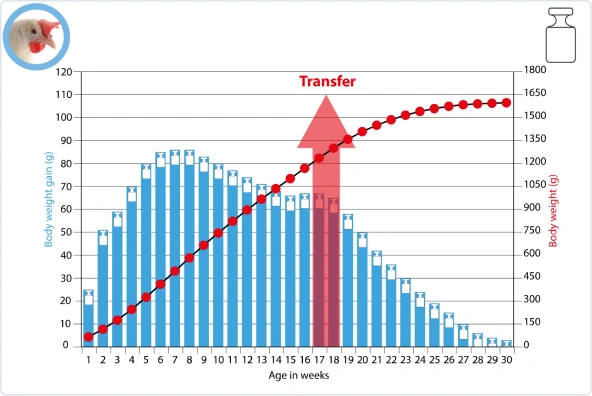
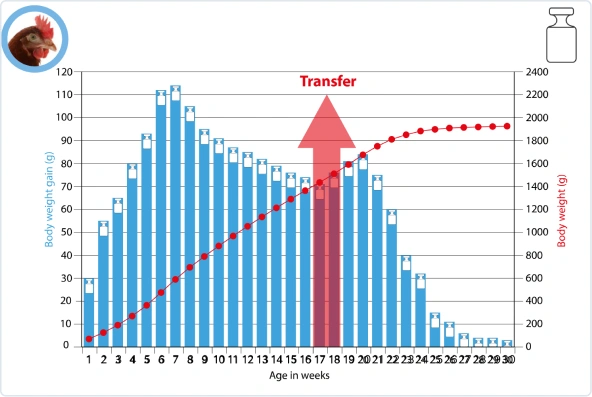
During the first days after housing, it is important to stimulate sufficient feed intake. The hens should increase their feed intake as fast as possible and continue gaining weight (see figure 1).
Some useful recommendations:
- Provide attractive feed with a good structure that avoids fine particles.
- Provide good quality, fresh water.
- Run the feeding lines frequently during the day.
- Feed on an empty feeder.
- Ensure there is enough light at the feeder.
- Light intensity should be higher in the laying house than in the rearing house.
- Avoid excessive stimulation when transferring birds to open houses.
Light and light programs
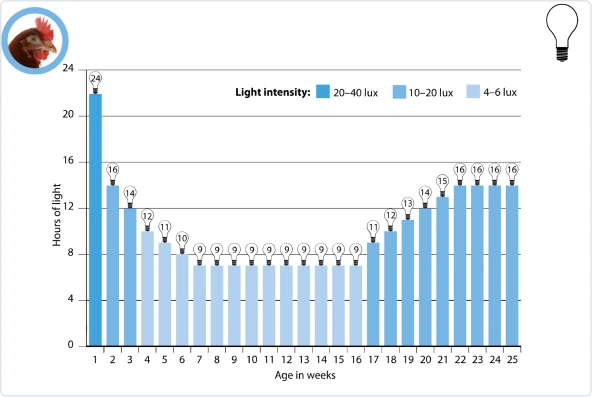
There are two main factors that stimulate the onset of laying in the flock:
- Body weight
- Photoperiod
In the absence of other stimuli, hens will begin to lay when they reach an appropriate body weight. However, the duration of the photoperiod can stimulate or delay the onset of lay as follows:
- Stable or increasing photoperiods with a duration exceeding 14 hours will early stimulate the onset of lay.
- Stable photoperiods with a duration of less than 14 hours will delay the onset of lay.
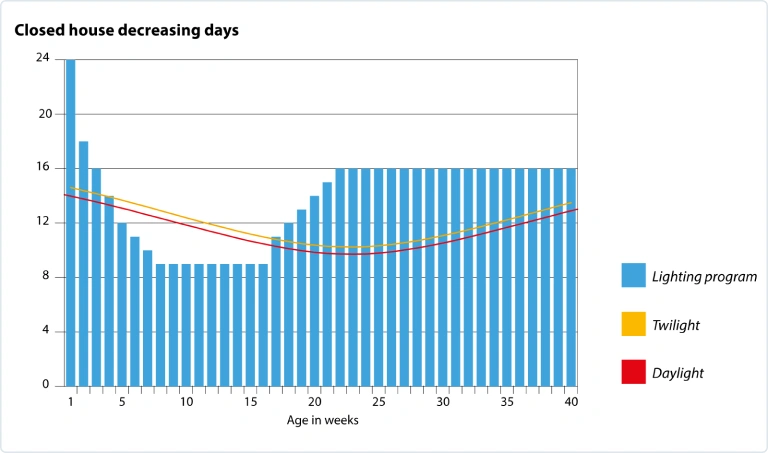
Decreasing photoperiods should never be used in production period.

Choose the right stimulation age
How to choose the right stimulation age
Normally a flock should be kept with a stable photoperiod until light stimulation starts. If hens are in the weight range, a standard recommendation for standard production is 119 days of life. However, this may vary according to two factors:
- Flock body weight status: If the birds’ body weight is far below the standard it is preferable to delay light stimulation for at least one week. Equally, if the CV is very high and the weight of part of the flock is far behind the standard, later light stimulation is preferable.
- Accumulated egg weight objective: Egg size strongly correlates with the size of the bird. A simple way to get heavier birds in the production onset is to delay light stimulation. Age at 50 % lay and body weight at 50 % lay are two values that can greatly help to forecast the egg weight.
How to deal with natural day length
The light program in open houses should take the natural day length at the stimulation age into account. Determine the light program during rearing as explained in the growing chapter. Stimulation should differ depending on the day length.
- Increasing day length period: Flocks risk being stimulated by natural light before they reach the correct body weight. To avoid this, the artificial day length should always be longer than the natural day length until the flock is ready to be stimulated. This should be considered in the rearing light program.
- Decreasing day length period: Flocks exposed to decreasing day length can show delayed onset of lay. To avoid this, create an artificial day length longer than the natural day length from week 10.
To achieve this goal, use the app: H&N lighting program.
Apply light stimulation in the flock
How to apply light stimulation in a flock
Once the light stimulation age is defined, light stimulation starts with an initial photoperiod increase. Take the following into account:
- Increase the day length at least one hour after sunset, or after switching off the lights.
- Light intensity control in the laying house should be slightly higher than in the rearing house.
- Light distribution should avoid dark area and shady areas.
- Keep light sources clear.
Subsequently, the photoperiod must be increased weekly. Light increases should be at least half an hour, although a higher increase is possible if the laying percentage increases rapidly. The more light hours the hens have, the more time they will use to consume feed. It is therefore important to achieve at least 14 hours of light to allow the flock to reach a proper feed intake.
Sexual maturation and onset of lay
At the start of their productive life, hens develop their secondary sexual characteristics. This is a good indication that the bird’s hormone development is correct. In addition to the start of the reproductive capacity, and therefore production of eggs, other changes occur in the bird’s metabolism.
One of the most important is the ability to capture calcium to create intramedullary bone. It is very important that the birds develop this type of bone to ensure good quality eggshells during the late lay period. Good practice is to use a pre-lay feed as explained in the nutrition chapter.


Management to peak production period
Feed
Ventilation & temperature
Water
Space
Onset of lay
% Lay
Body weight
Feed and water